
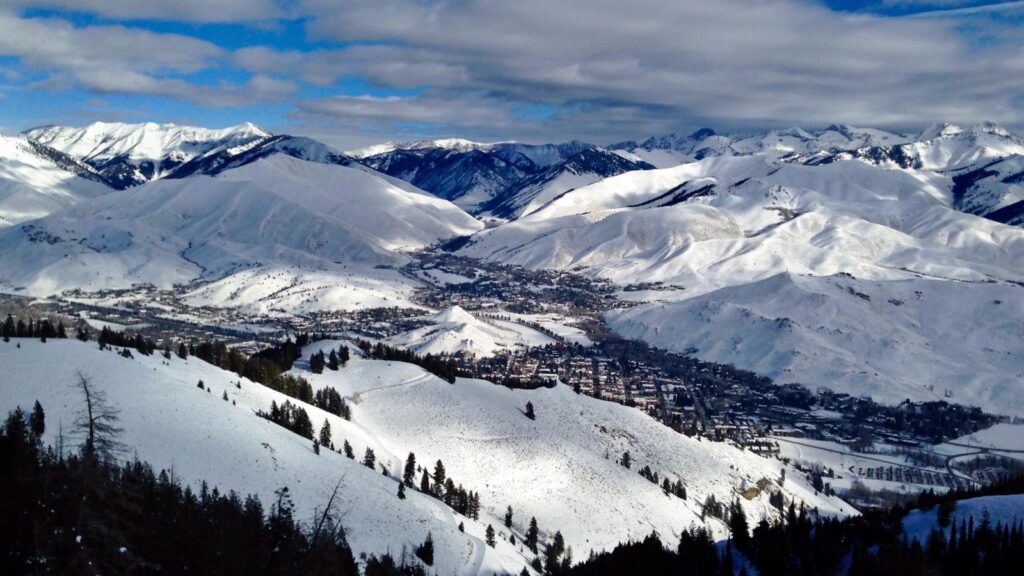
Sun Valley has been pulling travellers up into a high, bright corner of central Idaho since 1936, when it opened as America’s first destination ski resort. The name covers more than the resort: the village of Sun Valley itself, the old mining town of Ketchum a mile away, a serious ski mountain everyone calls Baldy, and a valley that runs north until the Sawtooths close it off. The things to do in Sun Valley Idaho fill both halves of the year: deep-winter skiing and Nordic trails, then summer rivers, singletrack and free concerts on a lawn.
The valley floor sits at nearly 6,000 feet, roughly 150 miles from Boise, and flights land at Friedman Memorial Airport in Hailey, just south of Ketchum. The old slogan — “winter sports under a summer sun” — still holds: winters are cold, snowy and bright, summers warm and dry. Start on the mountain; the village, the town and the wild country up the highway follow.
Bald Mountain: The Main Event, in Winter and Summer
Bald Mountain is the reason Sun Valley exists. Baldy tops out at 9,150 feet and drops a full 3,400 vertical feet to the base at 5,750 feet, one of the largest continuous verticals in American skiing. Skiers praise the consistency: runs hold a steady, honest pitch top to bottom instead of flattening into run-outs, and the grooming is famous. The two mountains together run more than 120 trails, and the season usually stretches from around Thanksgiving into mid-April.
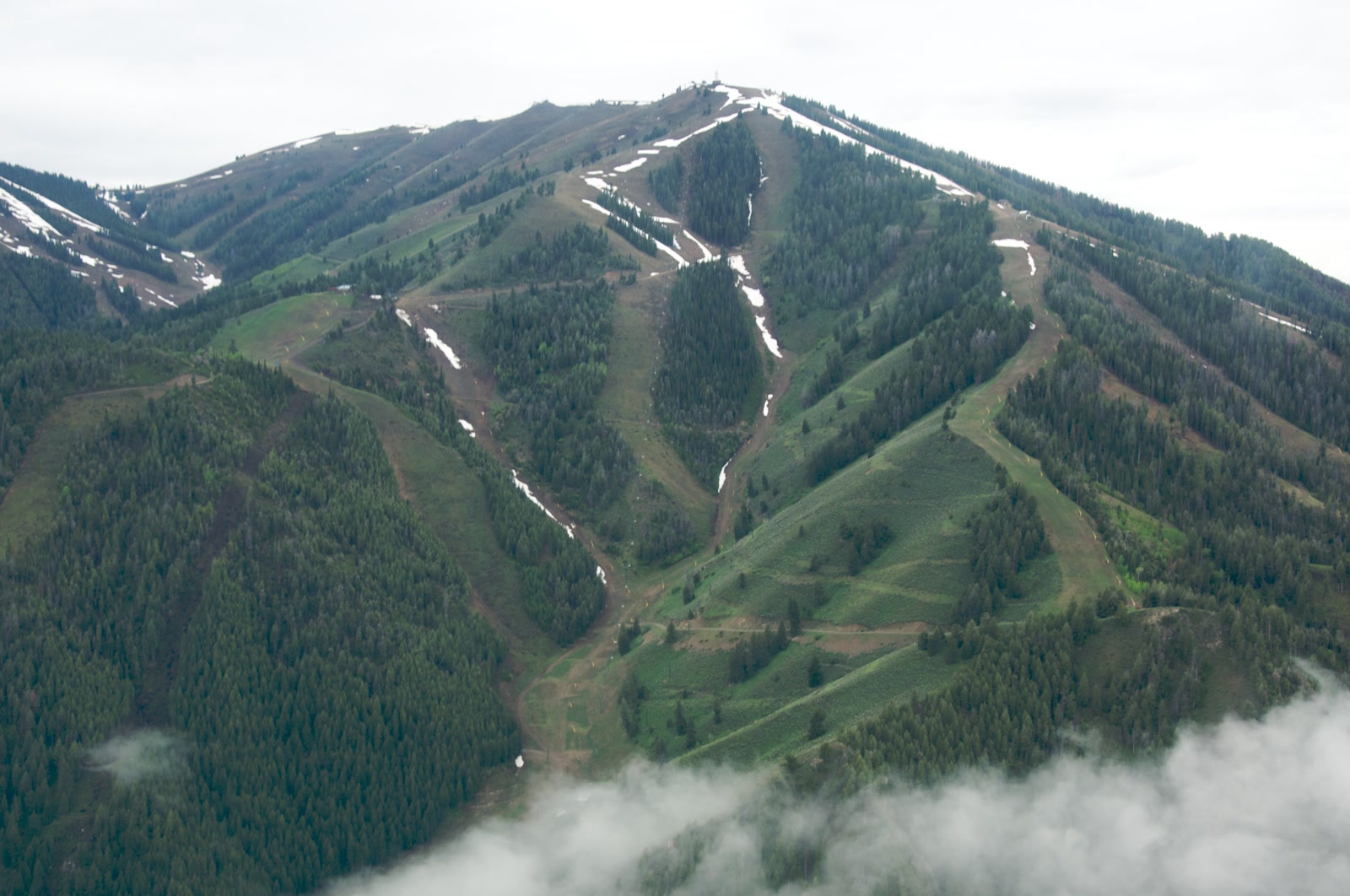
Come summer, the mountain does not close; it changes jobs. The Roundhouse Express Gondola carries sightseers, hikers and mountain bikers up to The Roundhouse restaurant, and trails fan out across the face you skied in February. Riding the gondola on a clear July morning, with the valley spread out below and the Pioneer Mountains across the way, is one of the valley’s simplest pleasures.
Dollar Mountain and the Village: The Gentle Side of the Resort
Sun Valley built beginners a whole second mountain. Dollar Mountain, right beside Sun Valley Village, is smaller, largely treeless and forgiving: 628 feet of vertical, gentle slopes, the resort’s terrain park and the ski school headquarters. First-timers learn here without Baldy looming over them, and confident kids graduate from Dollar to the big mountain like it is a promotion.
The village at Dollar’s feet is the resort’s living room. Shops and cafés cluster around a small lake, and the Opera House, built in 1937, still shows films in the heart of the village. The whole place keeps the tidy, alpine look the Union Pacific designers gave it in the 1930s, and nothing in it is far from anything else. Spend an unhurried hour here even if you stay in Ketchum; the two places are a mile apart and feel like different centuries.
Skate in the Sunshine: The Rink, the Ice Shows and Summer Concerts
The outdoor ice rink beside Sun Valley Lodge is one of the resort’s best surprises: it stays frozen and open all year, so you can skate outdoors in a T-shirt in July with the mountains around you. In summer the rink becomes a stage, when the Sun Valley on Ice shows bring Olympic and world-class skaters to perform under the open sky — a tradition from the resort’s early, glamorous decades.
The Lodge itself is worth a slow walk. It opened in December 1936, and its corridors are lined with photographs of the Hollywood guests who made Sun Valley famous — Clark Gable, Gary Cooper, Marilyn Monroe and more. Downstairs sits one of the Northwest’s oldest bowling alleys. And on summer evenings the whole village drifts toward the Sun Valley Pavilion, where the Sun Valley Music Festival’s orchestra plays free concerts for nearly four weeks from late July into August. Bring a blanket, sit on the lawn, and let a symphony play against the mountains.
Ketchum: A Mining Town That Kept Its Boots On
Ketchum was a working town long before it was a ski town. Founded in 1880 and first called Leadville, it grew up smelting lead and silver from the hills, and took its permanent name from David Ketchum, a local trapper and guide. When silver collapsed in the 1890s the mines faded and the valley turned to sheep, but Ketchum kept its streets, its saloons and its self-respect — the backbone that makes it more interesting than a purpose-built resort village.
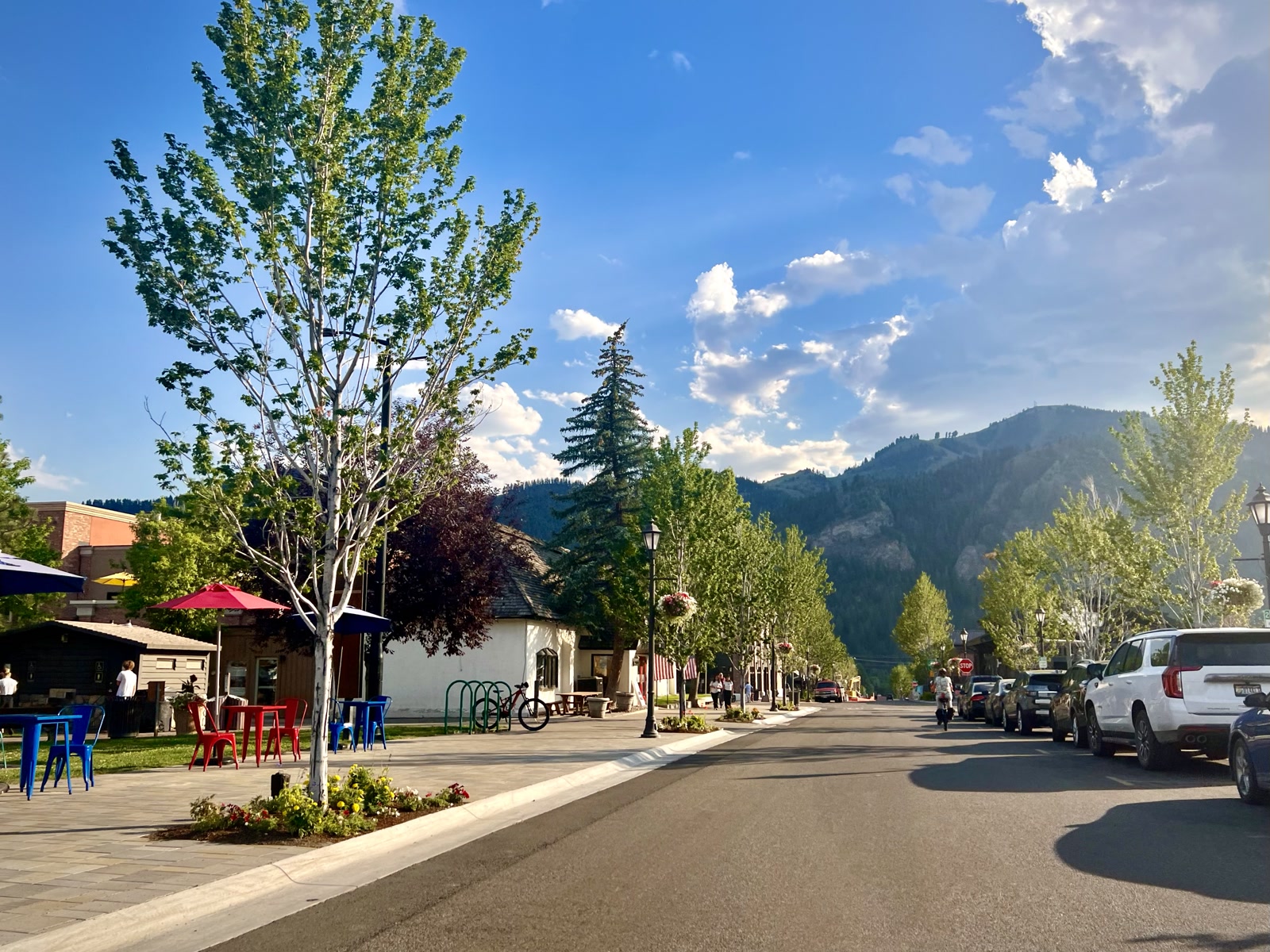
Today Main Street and its side streets hold galleries, bookshops, cafés and serious outfitters, and the Sun Valley Museum of Art, founded in 1971, anchors the cultural calendar. Twice a year the town’s history takes over the street itself. Over Labor Day weekend, Wagon Days rolls the Big Hitch Parade through downtown — horse-drawn Lewis ore wagons, buggies and stagecoaches in what is billed as the largest non-motorized parade in the Pacific Northwest. In October, the five-day Trailing of the Sheep Festival ends with some 1,200 sheep parading down Main Street. In March, the tone flips again for the Sun Valley Film Festival. Pick your Ketchum accordingly.
Following Hemingway: Room 206, a Grave and a Memorial
Ernest Hemingway arrived in 1939, and Sun Valley never quite let him go. He finished For Whom the Bell Tolls in Room 206 of the Sun Valley Lodge, returned to the valley on and off for twenty years, and spent his final years in Ketchum, where he died in 1961. For readers, the valley is a walkable chapter of his life.
His grave in Ketchum Cemetery is plain and easy to find, and visitors still leave pens and coins on it. A mile from the Lodge, off Trail Creek Road, the Hemingway Memorial stands above the creek he liked to fish, dedicated in 1966 with words from the novel he finished here. Neither stop takes long, but together they explain why this resort town keeps a writer at the centre of its story.
The Wood River Trail: Twenty Miles Without a Car
The valley’s best piece of infrastructure is a path. The Wood River Trail runs for more than 20 paved miles along the old Union Pacific rail bed, linking Bellevue, Hailey, Ketchum and Sun Valley in one flat, free, year-round route. The Blaine County Recreation District built it between 1984 and 1991 on the line that once carried the resort’s first skiers — the railway created Sun Valley, and its bed now moves the valley around without engines.
Locals call it simply “the bike path.” In winter the district grooms it for cross-country skiing, so the corridor works in every season. It also plugs into a much bigger web: the Sun Valley area counts over 400 miles of dirt singletrack and more than 30 miles of paved paths, hence as many bikes as cars in Ketchum in July.
Nordic Trails and Galena Lodge: The Quiet Winter
This valley takes cross-country as seriously as alpine. The Sun Valley Nordic & Snowshoe Center, based at the Sun Valley Club, grooms 37 kilometres of trails every day for classic and skate skiing. Add the North Valley trails toward Galena and the system grows into one of the largest Nordic networks in North America, nearly 100 miles of groomed and marked trails through silent, snowy forest.
The hub of that northern end is Galena Lodge, 23 miles up Highway 75 from Ketchum at about 7,300 feet. The lodge stands on the site of Galena, a mining town of the 1870s and 1880s, and is now a day lodge under a Forest Service permit — skiers and snowshoers in winter, hikers and bikers in summer. The drive alone, up the Big Wood River canyon with the Boulder Mountains rising on the right, is worth the trip. Go for the skiing; stay for soup by the fire.
Cast a Line: The Big Wood River and Silver Creek
The Big Wood River threads the whole valley, running right through Ketchum, and it is a genuine blue-ribbon trout stream: wild rainbow and brown trout, easy walk-and-wade access from town, and scenery that would justify the walk even if the fish refused to cooperate. Anglers fish it in the middle of town, in sight of Baldy.
For a pilgrimage, drive southeast to Silver Creek, near the little town of Picabo. Silver Creek is a spring creek — clear, slow and famously technical — where the trout are well educated and the dry-fly fishing is rated among the finest in the country. Between the Big Wood’s friendly water and Silver Creek’s examination paper, the valley covers both ends of a fly fisher’s education.
Over Galena Summit: A Sawtooth Day Trip to Redfish Lake
An hour north of Ketchum, Highway 75 — the Sawtooth Scenic Byway — climbs over Galena Summit at 8,701 feet, and the view from the overlook is the moment the day trip justifies itself: the whole Sawtooth Range laid out across the valley of the Salmon River, whose headwaters start right below you. Beyond the summit you are inside the Sawtooth National Recreation Area, 756,000 acres of protected mountain country with more than 700 miles of trails, 40 peaks above 10,000 feet and over 300 alpine lakes.
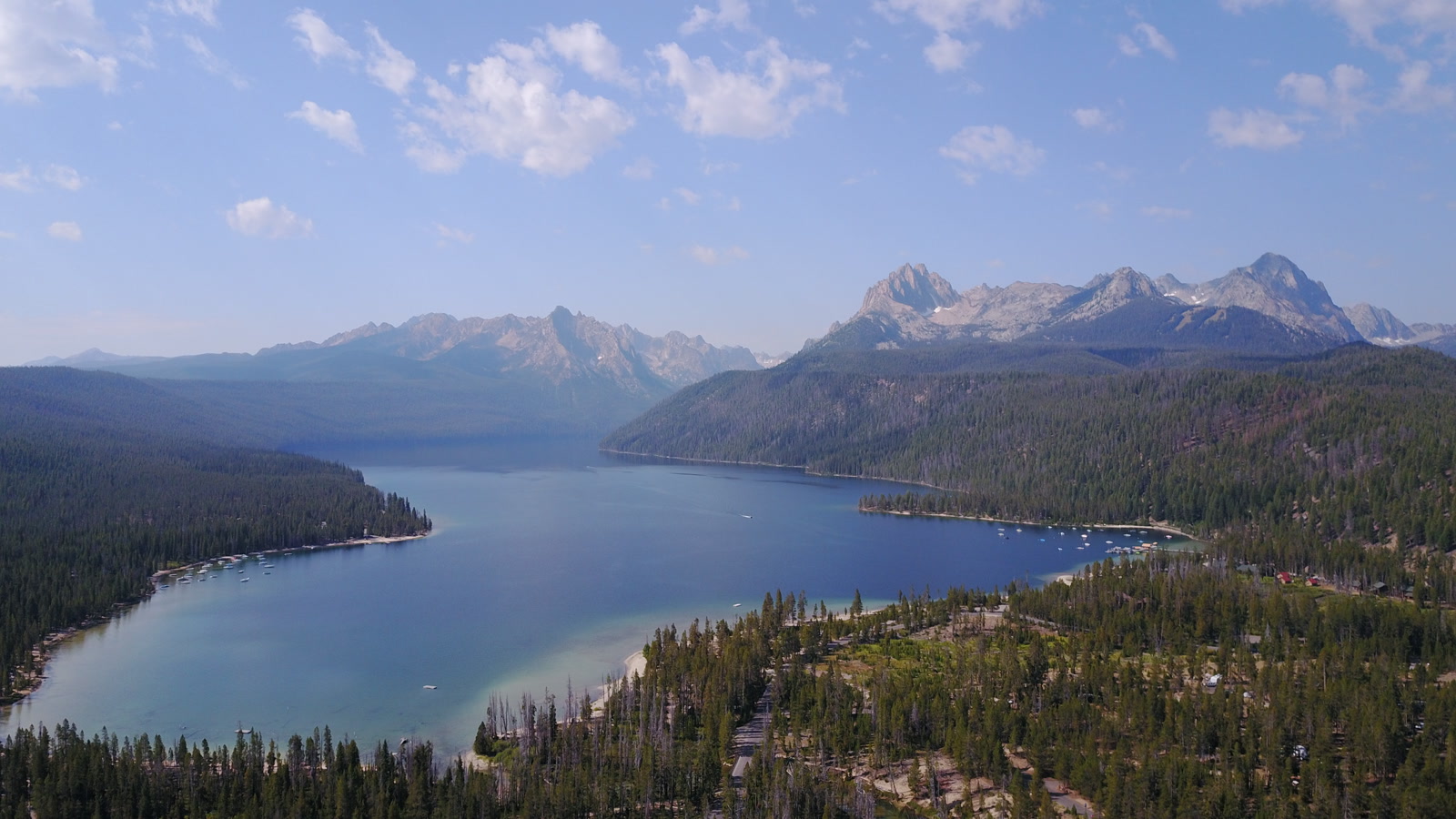
The drive’s natural target is Redfish Lake, the largest lake in the recreation area, about four and a half miles long, five miles south of tiny Stanley. There is a lodge on the north shore, a sandy beach, and a boat shuttle that ferries hikers to the trailheads at the far end of the lake, under Mount Heyburn. Swim if you are brave — the water is properly cold — or sit on the beach and watch the light move on the peaks. Leave Ketchum after breakfast and you can be back for dinner, but nobody who has seen the Sawtooths drives away without planning the longer stay.
After Dark, Literally: America’s First Dark Sky Reserve
Most resorts end the day at dinner. Sun Valley’s last act starts when the lights go down — which, here, they genuinely do. In December 2017 the International Dark-Sky Association designated the Central Idaho Dark Sky Reserve, the first in the United States, Gold Tier, covering 906,000 acres from Ketchum and Sun Valley to Stanley. Ketchum itself is a designated Dark Sky Community and has kept a lighting ordinance since 1999, so the Milky Way is not a rumour here; on a clear, moonless night it stands straight overhead.
You do not need a telescope or a plan. Walk ten minutes out of town on the Wood River Trail, drive up Trail Creek, or stop at Galena Summit on the way back from Redfish Lake, and the sky does the rest. It is the rarest of the things to do in Sun Valley Idaho: a famous resort where the darkness is protected as carefully as the skiing.
Sun Valley Questions, Answered
Is Sun Valley only a winter destination?
No. Skiing built the place, and December to March is peak season on Baldy, but late June to early September is a second high season of hiking, biking, fishing, golf and free outdoor concerts; spring and late autumn are quiet shoulder months.
How many days do you need?
Two or three days cover the mountain, the village and Ketchum. Add a fourth for the Sawtooth day trip to Redfish Lake — or give the Sawtooths a night in Stanley.
How do you get there?
Flights land at Friedman Memorial Airport in Hailey, just south of Ketchum; Boise’s airport is roughly 150 miles by road. Ketchum is walkable and the Wood River Trail links the towns, but a car makes the Galena and Redfish trips far easier.
What is the one thing first-timers miss?
The scale of the backcountry. The resort and Ketchum are polished and compact, but 756,000 acres of the Sawtooth National Recreation Area begin less than an hour north. Do not leave without at least driving over Galena Summit.