
Colorado sits on a crack in the continent, and the water keeps the receipts. All over the state, hot mineral water rises out of the mountains and gets caught — in giant resort pools, in stone tubs in the forest, in one case in a creek itself. The best hot springs in Colorado are not ten versions of the same soak. They range from the largest hot springs pool on Earth to a pool you can only reach by hiking eight and a half miles into a wilderness, and picking the right one matters more than picking the most famous one. This guide covers ten springs worth planning a trip around, with the facts that decide a visit: how hot the water is, and what you have to book.
One warning before the list. Colorado hot springs run on rules that surprise people. The prettiest rustic spring takes no cards and no walk-ins. The wildest one needs a federal permit to camp beside. The most luxurious one will not sell you a day pass at any price. Read the booking notes and you will not waste a drive.
Glenwood Hot Springs Resort: The Biggest Pool in the World
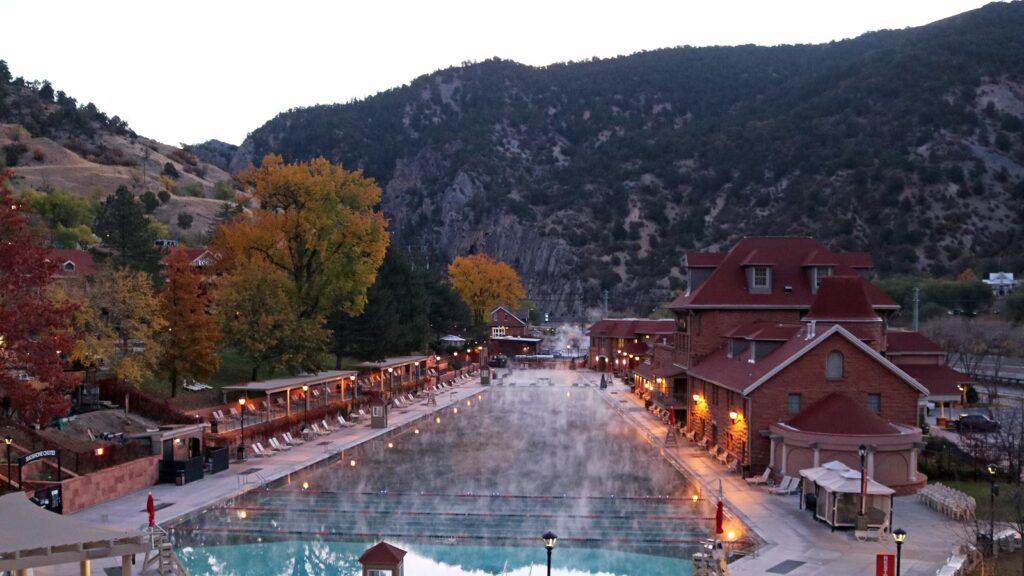
Start with scale. Glenwood Hot Springs Resort has been open since 1888, and its Grand Pool is the largest outdoor mineral hot springs pool in the world: 405 feet long, 100 feet wide, holding just over a million gallons of water. It is kept at 90 to 93 degrees Fahrenheit, warm enough to swim in properly rather than just sit, with diving boards and lap lanes. Beside it, the smaller Therapy Pool runs at a serious 104 degrees — the one you slide into when your shoulders need work.
All of it is fed by the Yampah spring, which comes out of the ground at 122 degrees and delivers about three and a half million gallons a day, carrying fifteen minerals. A newer area, the Yampah Mineral Baths, adds smaller pools at stepped temperatures, including cold plunges for anyone who likes the hot-cold shock. The honest verdict: this is the family default and the easiest recommendation in the state. It sits right in the town of Glenwood Springs beside the Colorado River, and nobody has to book a timed slot or learn a rulebook. If your group includes kids, swimmers and one person who just wants to float, start here.
Iron Mountain Hot Springs: Sixteen Pools Along the River
A mile west along the same river, Iron Mountain Hot Springs does the opposite of one big pool. Opened in 2015 on a bank where people have soaked since 1897, it spreads sixteen small geothermal pools along the Colorado River, each held at a different temperature between 98 and 108 degrees. You wander, you test, you settle. There is a large family pool too, and across the property the count reaches thirty-five mineral pools.
The headline act is WorldSprings, an adults-only area for guests 21 and over that opened in 2023. Its pools recreate the mineral recipes of famous springs around the world — Iceland’s Blue Lagoon, the Dead Sea, Japan, Italy and others — a world tour of water without leaving Glenwood Springs. The trade-off is structure: visits run on reservations, in timed three- or five-hour soaks, and children under five are not allowed in the small mineral pools. Book the slot, then relax. For couples who like choosing their exact temperature, this is the better Glenwood address.
Strawberry Park Hot Springs: Stone Pools, Cash Only, Book the Slot
Seven miles up a forest road from Steamboat Springs, Strawberry Park is the rustic classic: hand-built stone pools stepping down a wooded valley beside Hot Springs Creek, open year-round, with snow falling through the steam in winter. It is also the spring most likely to turn you away, because its rules are strict and stated in capital letters on its own website.
Every pool visit needs a reservation, in a two-hour slot, and reservations open thirty days ahead. There is no waitlist, and a reservation only covers the slot you booked. Payment is cash only — no credit cards, no checks, and no ATM on site, so stop in town first. After dark the pools become clothing-optional and adults-only, which families should know before booking an evening slot. And from November to May, county law requires four-wheel or all-wheel drive with snow tires or chains for the last two unpaved miles; two shuttle companies run from Steamboat if your car does not qualify. None of this is fine print. It is the price of a small, quiet place that refuses to be overrun — and most visitors leave thinking the rules are exactly why it works.
Mount Princeton Hot Springs Resort: The Soak Inside the Creek
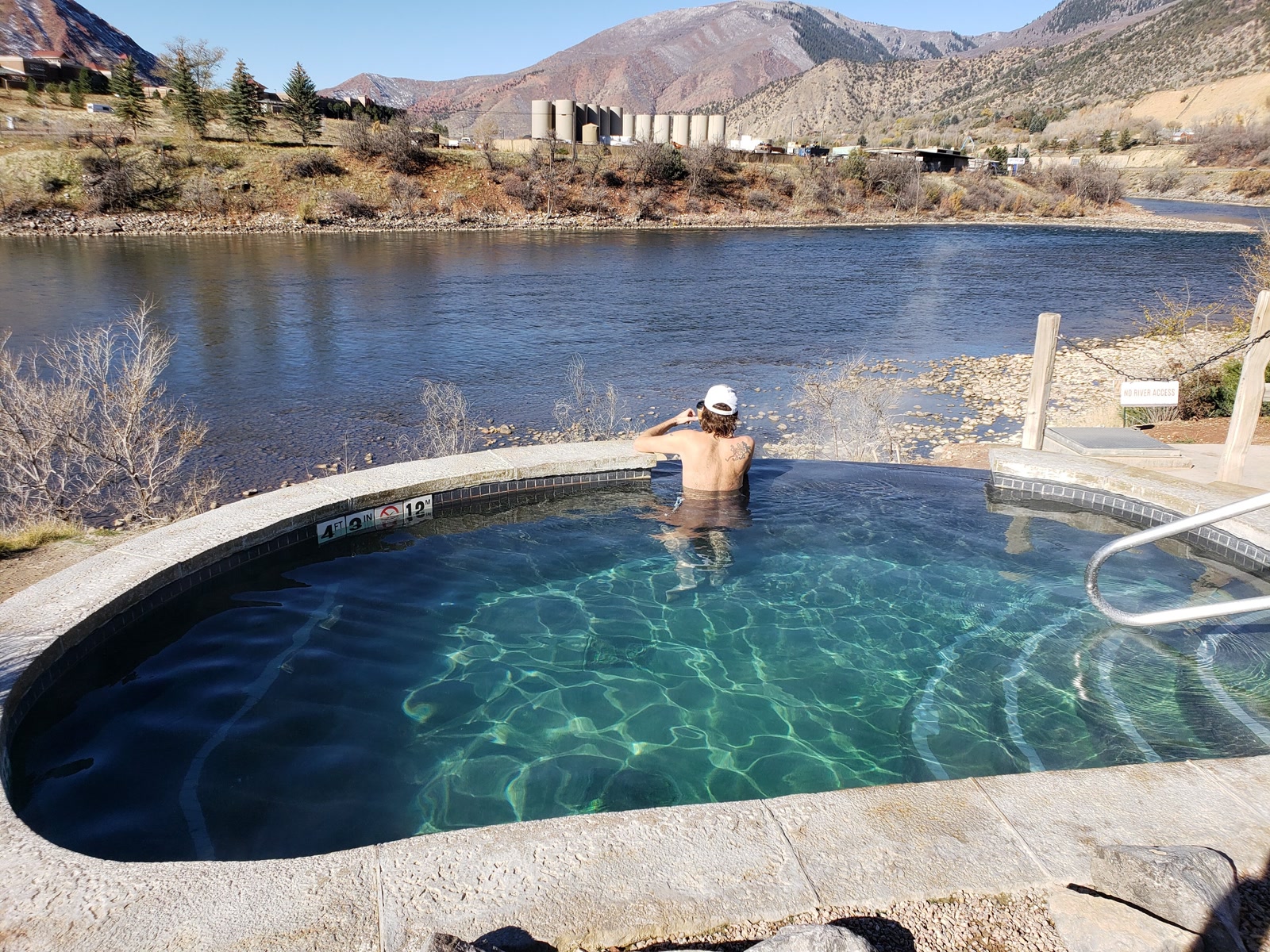
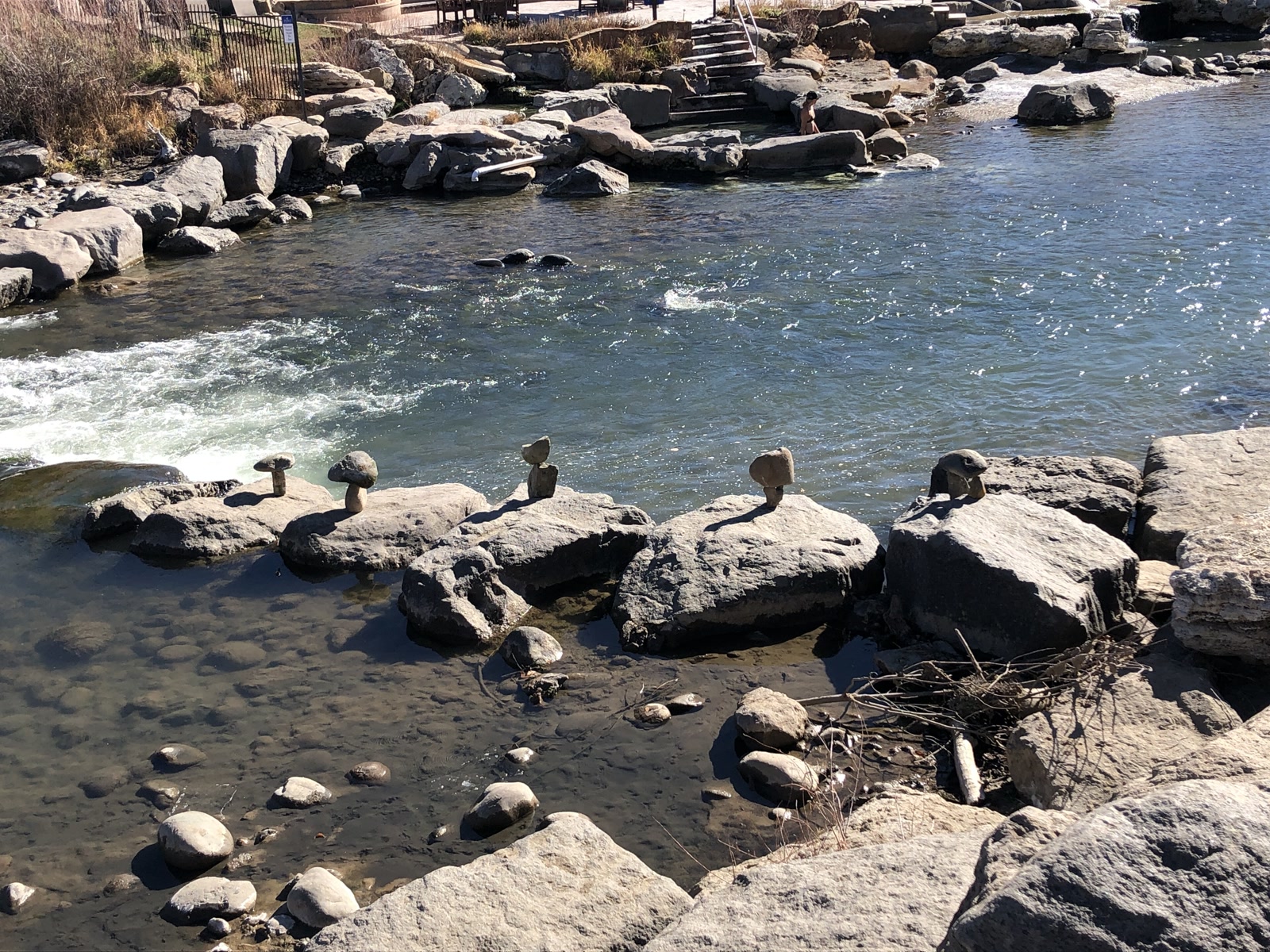
Mount Princeton, near Nathrop between Buena Vista and Salida, has the strangest and best trick on this list. The resort’s geothermal water surfaces at up to 140 degrees, and along Chalk Creek below the bathhouse it bubbles straight up through the creek bed into natural rock-ringed pools. The creek water is snowmelt-cold and the spring water is scalding, so each little pool lands somewhere between 33 and 120 degrees — and you tune your own pool by moving rocks, letting more cold creek water in or damming it out. It is soaking as a small construction project, and it is wonderful.
If you would rather not engineer your bath, the developed side is strong too. The Historic Bath House, dating to 1887, holds a Soaking Pool at about 105 degrees and an Exercise Pool in the low nineties, and an infinity pool runs at about 104 degrees year-round under the Chalk Cliffs. The water is non-sulfurous, so there is no rotten-egg smell. Two practical notes: day passes are sold at the bathhouse with no advance reservation needed, and the creekside pools are seasonal — when snowmelt sends Chalk Creek high, they close until the water drops.
Cottonwood Hot Springs: The Quiet Pools Down the Road
Fifteen minutes west of Buena Vista, up Cottonwood Creek, Cottonwood Hot Springs Inn & Spa is what Mount Princeton’s quieter neighbour looks like. It is a small, unpolished, deliberately calm place: a row of stone soaking pools at stepped temperatures, a dry sauna, and a cold plunge in the creek. The operator publishes its pool temperatures by name, which tells you the spirit of the place — the Head pool at 104 degrees, the Elbow at 106, the Belly at 85, a Watsu pool at 90, and the cold plunge at 80.
Nothing artificial is added to the water, swimsuits are required at all times, and the whole property leans into quiet rather than scene. There is a small inn and cabins if you want to stay over, and soaking runs from morning to late evening. Choose Cottonwood when the big resorts sound like work: it is the soak for readers and thinkers. Pair it with Mount Princeton on the same Arkansas Valley trip and you get the region’s two personalities in one weekend — the creek you build yourself, and the pools that ask nothing of you at all.
The Springs Resort at Pagosa Springs: Fifty Pools, One Record-Breaking Spring
Pagosa Springs has the best single fact in Colorado hot springs. Under the town runs the Mother Spring, which Guinness World Records recognises as the deepest geothermal hot spring on the planet. In 2020, teams from the Colorado School of Mines and the US Geological Survey lowered a line more than 1,002 feet into it and never touched bottom. Nobody knows how deep it really is. The water surfaces at about 144 degrees, loaded with thirteen naturally occurring minerals, and The Springs Resort is built on its bank above the San Juan River.
You cannot soak in the Mother Spring itself — it would cook you — but it feeds more than fifty terraced pools across the resort, running from cold plunges around 35 degrees to hot soaks up to about 112. Staff post each pool’s temperature, so you can climb or descend the terraces by heat. It is the widest temperature range of any resort on this list, in a setting right in downtown Pagosa Springs with the river below. If you only visit one hot springs town in southern Colorado, make it this one, and give it a full day rather than an hour.
Hot Sulphur Springs Resort: Colorado’s Old Original
The town of Hot Sulphur Springs is named for its springs, and the resort on the slope above the Colorado River is as close as Colorado gets to the original article. The Ute people used these springs as a winter camp long before there was a town; the resort’s commercial history runs back to the 1860s, and its motel has operated since 1943. Around twenty mineral pools step down the hillside at 98 to 112 degrees.
The defining detail is what the resort does not do. The water is used exactly as it comes out of the ground — no chlorine, no filters, no pumps. Gravity alone moves it from pool to pool. That makes Hot Sulphur the purist’s pick and, honestly, the rough-around-the-edges pick too: expect a working, historic, family-run place rather than a polished spa. The compensation is real. There are no reservations for the pools; you simply walk in, any day of the year. For travellers crossing Grand County, it is the easiest spontaneous soak in the state, and the one that feels most like the nineteenth century it came from.
Orvis Hot Springs: Clothing Optional, Phones Away
Orvis Hot Springs, just south of Ridgway facing the San Juan Mountains, is the free spirit of the list. Its water is natural lithium-rich mineral water that is never heated, never treated and never chlorinated, spread across ten soaking areas in a garden-like yard. The main Pond, forty feet across, runs between 100 and 106 degrees with hot spots bubbling up through its pebble floor. At the other extreme, the Lobster Pot is the hottest tub in this guide at 108 to 114 degrees — a short-soak pool, named honestly. There is a cold plunge, an indoor pool and two private tubs as well.
Two rules shape the place. Clothing is optional for adults outdoors — under-18s wear swimsuits — and plenty of guests stay suited, so treat it as relaxed rather than required. And phones and cameras are banned in the soaking areas, full stop, which regulars will tell you is the real luxury. Day soaking needs no reservation. Come here on a Million Dollar Highway trip between Ouray and Telluride, when what you want is a long, quiet, screen-free soak under a very large sky.
Conundrum Hot Springs: The Soak You Have to Earn
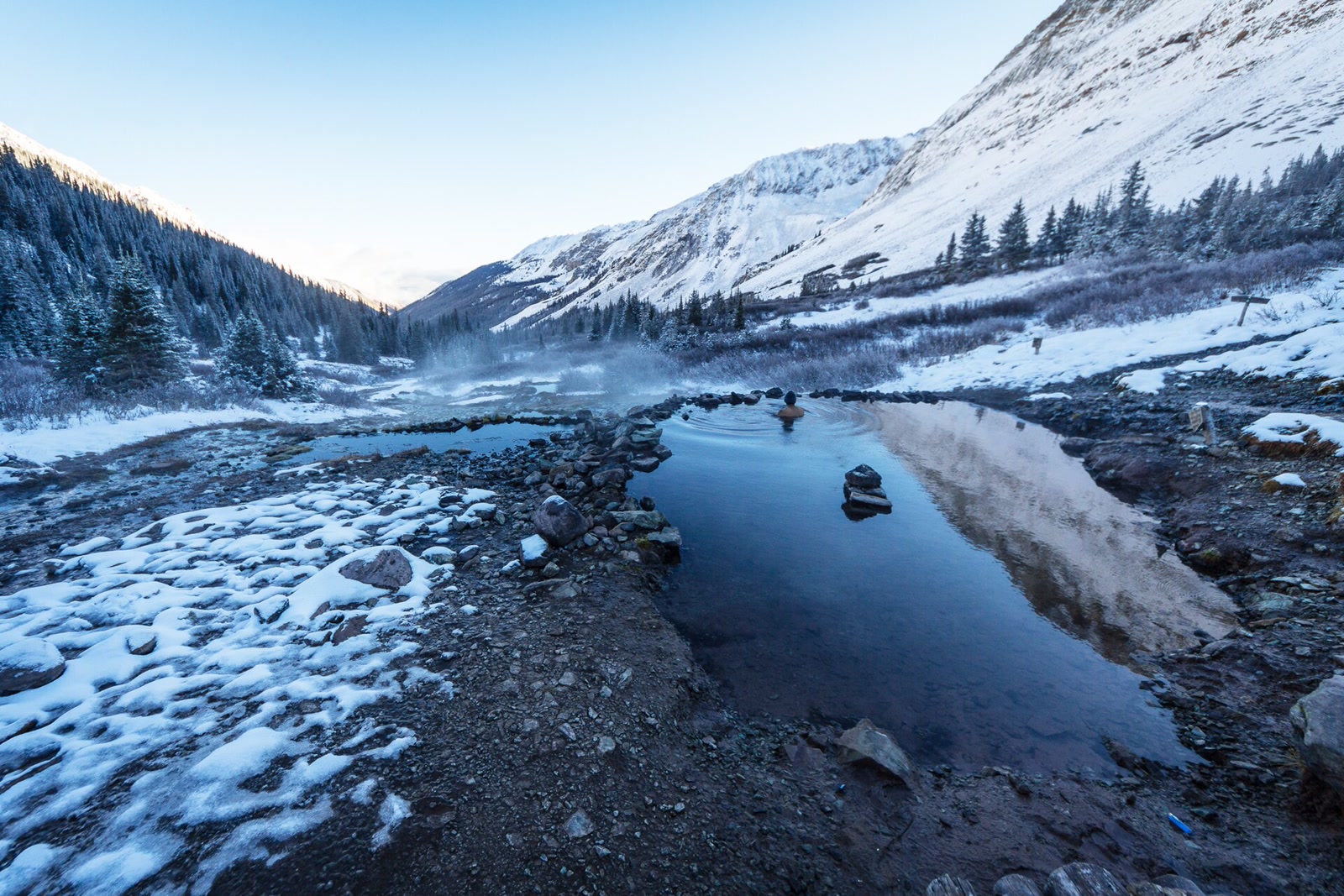
Conundrum is the outlier: no building, no till, no road. The pools are natural rock basins at about 11,200 feet at the head of Conundrum Creek in the Maroon Bells-Snowmass Wilderness, south of Aspen, holding water around 98 to 104 degrees under a ring of high peaks. Getting there means the Conundrum Creek Trail — eight and a half miles one way, with roughly 2,500 feet of climbing. Most people make it an overnight trip, and that is where the rules live.
Day use is free and needs no permit. Camping in the Conundrum permit zone, though, requires an advance permit booked through Recreation.gov, for one of twenty designated numbered campsites. In the main season, May 1 to October 31, the permit costs ten dollars per person per night, plus a small reservation fee. Bear-resistant food canisters are required, and dogs and campfires are banned in the zone. The Forest Service’s season advice is simple: July to September. Outside that window the trail is buried in snow and the trailhead is out of reach. Time it right and this is the finest soak in Colorado — a warm pool at treeline, earned the hard way. Time it wrong and it is not a soak at all.
Dunton Hot Springs: A Ghost Town With a Bathhouse
At the far end of the scale sits Dunton, a restored 1885 mining town in the San Juan Mountains near Dolores. The mines gave out by 1918 and the town emptied; today its hand-hewn log cabins, saloon and dance hall form an all-inclusive luxury resort, bookable cabin by cabin or as a whole town for a wedding or retreat. The hot springs are five or six calcium-bicarbonate pools at 85 to 106 degrees, including the pool inside the restored nineteenth-century bathhouse and a private spring in one special cabin, the Well House.
Here is the catch, stated plainly: Dunton does not sell day passes. The springs are for overnight guests only, and a stay includes all meals and drinks, which puts it in special-occasion territory. Include it anyway, because “best” should mean best. If you are planning the one big celebration trip — a honeymoon, a milestone birthday — this is the ceiling of what Colorado hot springs can be: a whole ghost town, a bathhouse, and nobody else around.
How to Pick From the Best Hot Springs in Colorado: Booking Rules and Seasons
Match the spring to the trip. Families and mixed groups: Glenwood Hot Springs, with Mount Princeton close behind. Couples who like control and quiet: Iron Mountain’s WorldSprings, or Orvis with its phones-away rule. Purists: Hot Sulphur Springs, where nothing is added and nothing is pumped. Romantics with patience: Strawberry Park, booked thirty days out with cash in pocket. Hikers: Conundrum, in the short high summer. Celebrations: Dunton, if the budget stretches, and Pagosa for everyone else — no other town gives you fifty pools and a world record in one stop.
Three habits will improve any soak on this list. Book what must be booked the day you fix your dates — Strawberry Park’s slots and Conundrum’s permits go first. Respect the heat: pools above 104 degrees are for short dips, not long sits, and the cold plunge between soaks is part of the craft, not a dare. Finally, go in winter if you can. Every spring here is open year-round, and hot water under falling snow, with the crowds thinned to locals, is the version of Colorado soaking people write home about. The mountains made the water. All you have to do is choose your pool.