
Maine lighthouses are the image on every postcard of the state, and they are also the part of a Maine trip most people get wrong. Maine has 65 historic lighthouses along its coast, more than any other state except Michigan, and roughly two-thirds of them stand on ledges and islands you cannot reach. The trick is to know which lights you can drive up to, which ones you can only admire from shore, and which ones need a boat.
The Short Answer: Which Maine Lighthouses to See First
If you have one day, start in Portland: Portland Head Light, Two Lights, Spring Point Ledge and Bug Light all sit within a few miles of each other. With three days, keep driving north: Nubble Light in York, Pemaquid Point on the Midcoast and Bass Harbor Head on Mount Desert Island fill day two, and West Quoddy Head finishes the trip.
| Light | Where | Getting there |
|---|---|---|
| Portland Head Light | Cape Elizabeth | Drive up, free park |
| Two Lights | Cape Elizabeth | Drive up, state park |
| Spring Point Ledge | South Portland | Walk the breakwater |
| Bug Light | South Portland | Drive up, park |
| Nubble Light | York | View from Sohier Park |
| Pemaquid Point | Bristol | Drive up, park fee |
| Owls Head | Owls Head | Short walk in state park |
| Marshall Point | Port Clyde | Drive up, free grounds |
| Rockland Breakwater | Rockland | Walk the breakwater |
| Bass Harbor Head | Mount Desert Island | Drive up, short trail |
| West Quoddy Head | Lubec | Drive up, state park |
| Seguin Island | Off Popham Beach | Summer ferry only |
One rule runs through the whole list: the grounds of most lights are open all year, but the towers are usually closed, seasonal, or open only on a handful of volunteer-run days. Check the operator’s site before building a day around a tower climb.
Portland Head Light: The One on Every Postcard
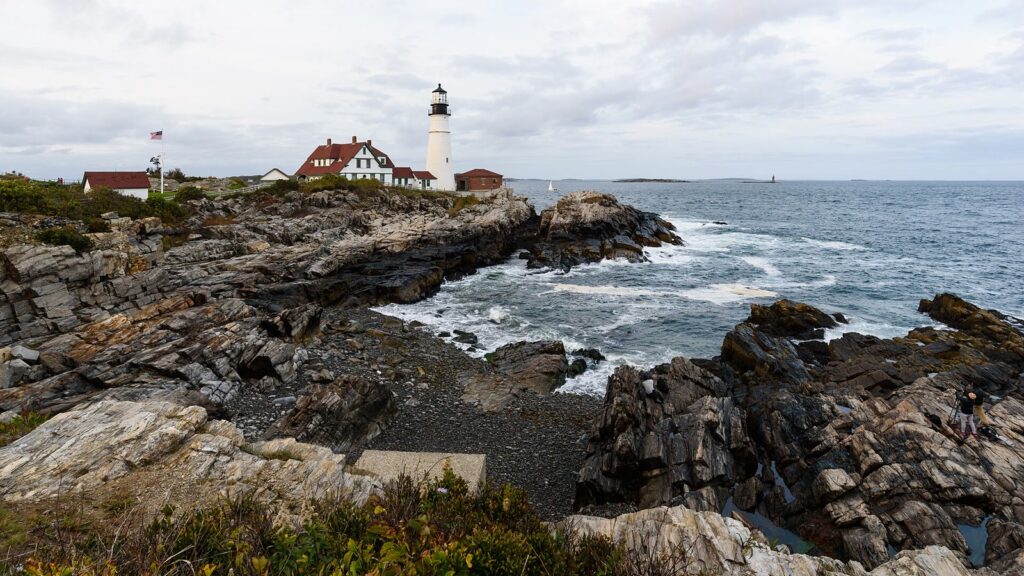
Portland Head Light is the lighthouse most people picture when they hear the word Maine. Commissioned by George Washington in 1791, it is the oldest lighthouse in the state and the first built by the United States government. The white tower stands on the rocky point of Fort Williams Park in Cape Elizabeth, with the keeper’s house beside it, and the view takes in the harbour entrance, the islands of Casco Bay and the open Atlantic.
The park is free and open year-round from sunrise to sunset, which makes this the easiest lighthouse in Maine to visit and also the busiest. Parking costs $6 for the first two hours, then $2 an hour, and the lots fill on summer weekends, so come early or late. The museum, in the former keeper’s quarters, is open daily 10 a.m. to 4 p.m. from Memorial Day to Indigenous Peoples Day, and weekends in May and November; admission is $2 for adults and $1 for ages 6 to 18, under-6s free. The tower opens only one day a year, on Maine Open Lighthouse Day each September.
The Portland Harbour Trio: Two Lights, Spring Point and Bug Light
Cape Elizabeth holds a second lighthouse stop a few minutes from Portland Head, and South Portland holds two more, which is why the Portland area works so well as a first day. Two Lights State Park is named for its pair of towers on the headland, one of which still guides ships while the other stands as a landmark; you view them from the park’s paths and picnic ledges, and neither tower opens to visitors.
Across the harbour in South Portland, Spring Point Ledge Light is the one to walk to. It stands at the end of a 950-foot granite breakwater, and it is the only caisson-style lighthouse tower in the country that you can walk up to. A few minutes away in Bug Light Park stands the Portland Breakwater Light, known to everyone as Bug Light: a small, neat tower on the harbour’s edge, easy to reach, free to visit, and the best place in the city to watch the working waterfront.
Nubble Light: The Postcard on Its Own Island
Nubble Light is the most photographed lighthouse in Maine after Portland Head, and it is also the one that teaches the access lesson fastest. Its official name is Cape Neddick Light Station, and it stands on a small rocky island about a hundred yards off the tip of Cape Neddick in York. There is no bridge, no ferry and no tour, and the island is closed to the public.
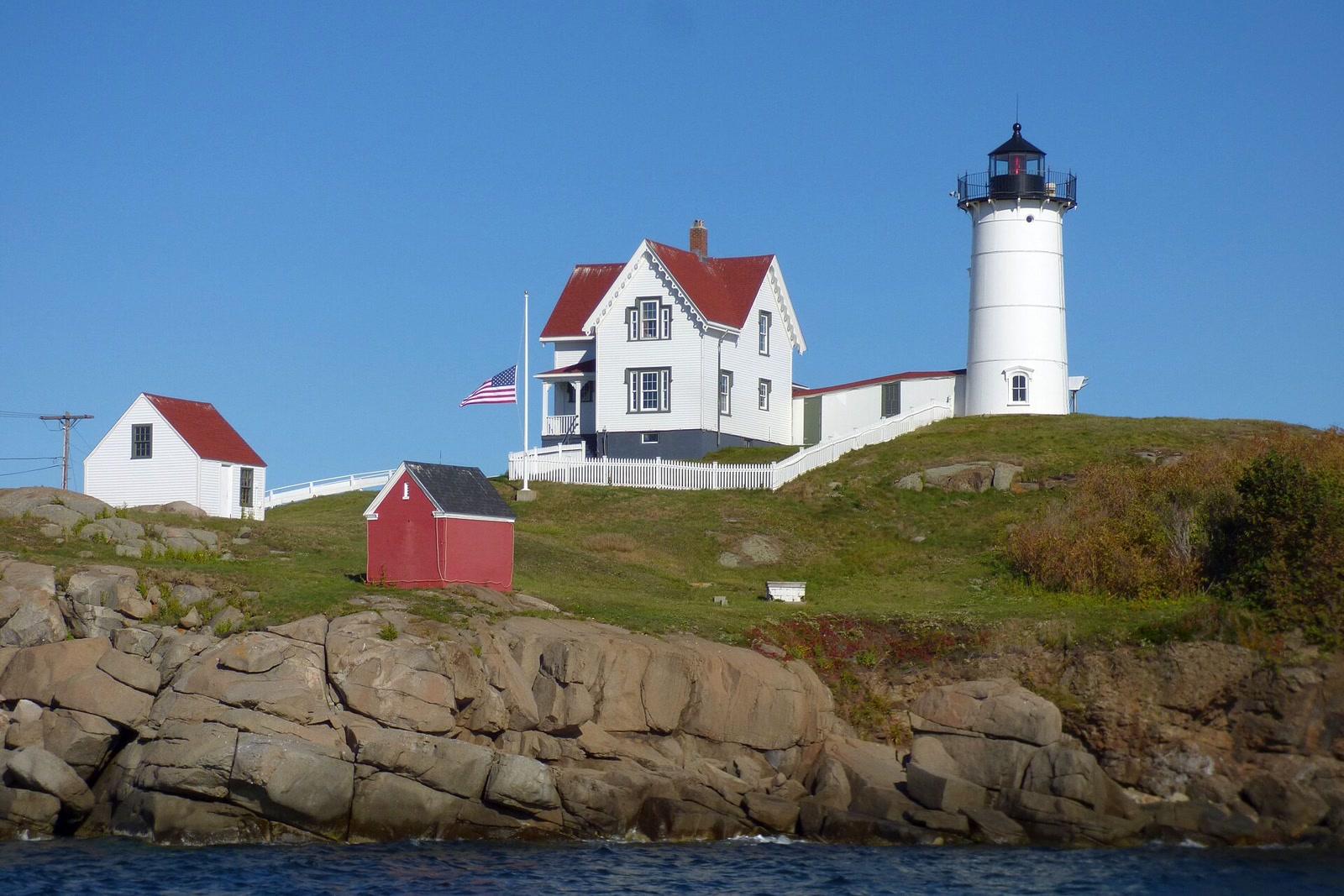
What you get instead is one of the best short-range lighthouse views in New England, from Sohier Park on the mainland side. The white cast-iron tower, first lit on July 1, 1879, stands 41 feet tall on an islet that lifts its light about 88 feet above the water, and the red-roofed keeper’s house, the covered walkway and the red oil house line up beside it in a single composition. The original fourth-order Fresnel lens is still in use. Parking at Sohier Park is free, but there are only about fifty marked spaces for a lighthouse that draws bus tours, so the lot fills before most people finish breakfast in July and August. Go before nine in the morning, or walk out from Long Sands Beach, fifteen to twenty minutes along the shore road.
Pemaquid Point: The Quarter, the Ledges and a Tower You Can Climb
Pemaquid Point is the lighthouse on the Maine state quarter, and it is also the one lighthouse on this list where climbing the tower is a normal part of the visit. The station was commissioned by President John Quincy Adams in 1827, but the first tower was built with salt water in its mortar and began to crumble, so the tower standing today was rebuilt in 1835. In 2003 the U.S. Mint put Pemaquid Point on the Maine quarter, the first lighthouse ever to appear on American currency.
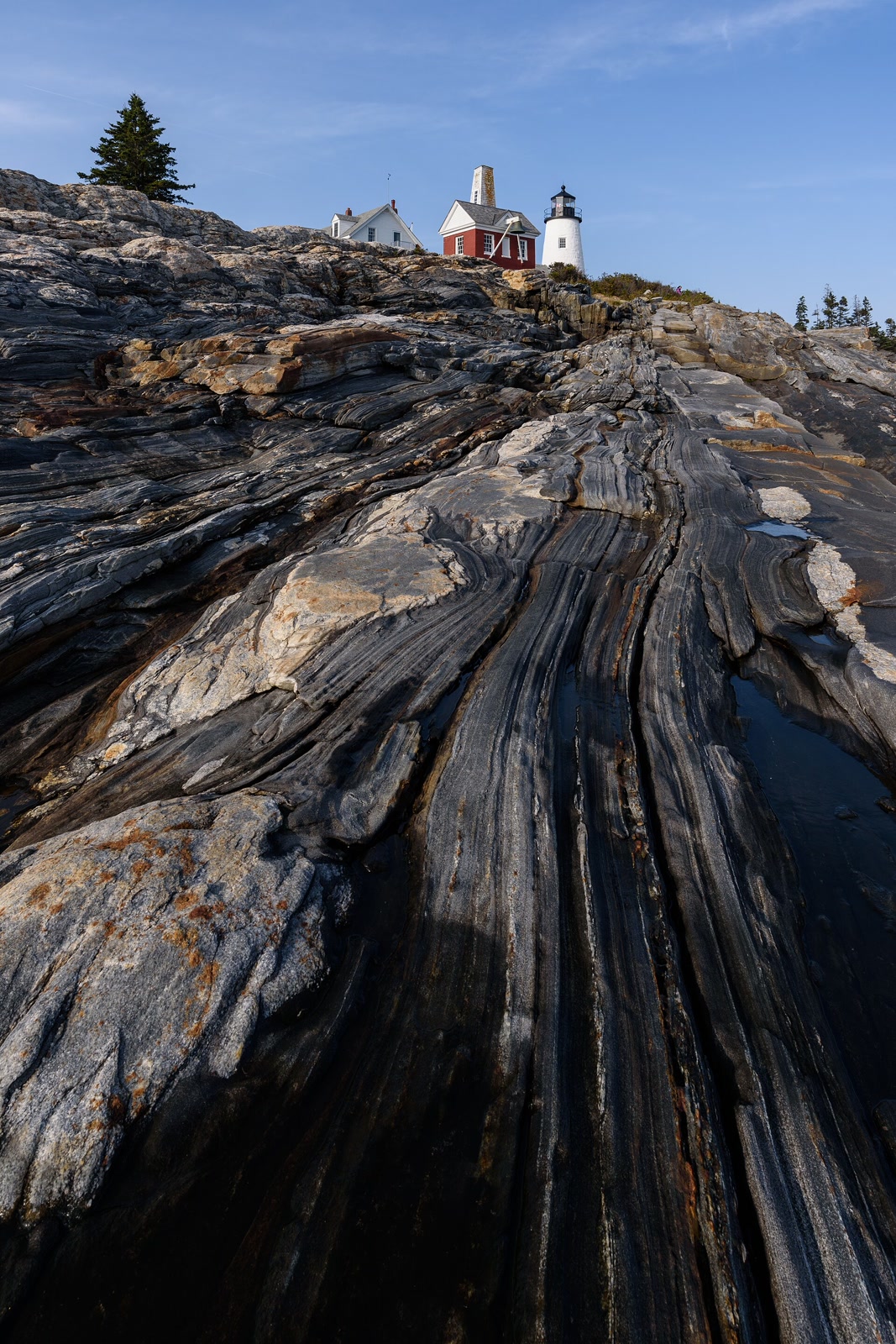
The setting is as famous as the history. The lighthouse stands on an apron of wave-fractured granite ledges, striped in bands of light and dark rock, that slope down to the sea like steps. The park is open daily from 9 a.m. to 5 p.m. from mid-May to mid-to-late October, and admission is $4 for adults and children 12 and older, $1 for children 5 to 11, with under-4s free. That covers the grounds, the Fishermen’s Museum in the 1857 keeper’s house, the art gallery and the learning centre. The tower is opened by volunteer docents from Memorial Day weekend to early October, weather permitting, for a suggested donation of $1 per person, with a 46-inch height requirement to climb. Come on a weekday if you can: the park draws more than 100,000 visitors a year, and the small lot fills fast on sunny weekends.
Owls Head and Marshall Point: The Quiet Midcoast Pair
Between Rockland and Port Clyde, two lighthouses sit a short drive apart and draw a fraction of the crowds that Portland Head and Pemaquid do. Owls Head Light was built in 1825 and stands inside Owls Head State Park at the entrance to Rockland Harbor, about 80 feet above Penobscot Bay. The walk in is part of the visit: a pleasant half-mile through the woods brings you to the keeper’s house and the tower on the headland, with views across the bay to the islands and the windjammer fleet.
Marshall Point, in the fishing village of Port Clyde, is the one film fans come for. The station was established in 1832, and the present tower was first lit in 1858. It appeared in the 1994 film Forrest Gump, as the end of Forrest’s cross-country run down the station’s long wooden runway, and the keeper’s house now holds a small museum, run by volunteers and open from Memorial Day through Columbus Day. The tower itself is not open to the public, but the grounds are free, the walk out along the runway is short and flat, and Port Clyde’s working harbour is a five-minute walk away.
Rockland Breakwater: The Walk Out to Sea
Rockland Breakwater Light is the lighthouse you earn on foot. The light was built in 1902 and stands at the end of a granite breakwater that runs just under a mile out into Rockland Harbor. The breakwater was built with more than 700,000 tons of granite and took over two decades to complete, and walking it is the whole point: the stones are uneven slabs, the harbour opens up on both sides as you go, and the lighthouse grows slowly larger until you are standing at its base with the town behind you and open water ahead.
Wear sturdy, closed-toe shoes and allow an hour for the round trip, more if you stop to watch the boats. The walk is not difficult, but the stones are uneven and there is no shade and no railing, so it is not a good choice in high wind, heavy rain or with small children who need carrying. The lighthouse itself is not open to the public, and that hardly matters: the breakwater is the attraction, and on a calm morning it is one of the most satisfying short walks on the Maine coast.
Bass Harbor Head: Acadia’s Cliff-Top Light
Bass Harbor Head Light sits on a sea cliff on the quiet side of Mount Desert Island, and it is one of the most photographed lighthouses in Maine for a simple reason: the setting does the work. The light was built in 1858 and stands above the rocks at the island’s southwestern tip, with the white tower and the keeper’s house framed by spruce and open water. It is the classic Acadia photograph, and the classic Acadia crowd problem, because the parking area is small and the site is on every tour of the island.
The tower is not open to the public, and the visit is really about the overlooks. Short, steep paths drop from the parking area to the rocky viewpoints below the light, and the best of them face west, which makes Bass Harbor Head one of the few Maine lighthouses that photographs better at sunset than at sunrise. Go late in the day, after the tour buses have moved on, and pick your way down carefully: the rocks are steep and can be slick, and the tide pools below are worth a slow look.
West Quoddy Head: Sunrise at the Eastern Edge of America
West Quoddy Head Light is the farthest east you can stand in the United States, and it looks the part. The tower is painted in red and white horizontal stripes, like a candy cane, and it stands on the tip of the Quoddy Head peninsula in Lubec, looking across Quoddy Channel to the red cliffs of Grand Manan Island in New Brunswick. The first light here was built in 1808, commissioned by President Thomas Jefferson, and the station has marked the entrance to the Bay of Fundy ever since.
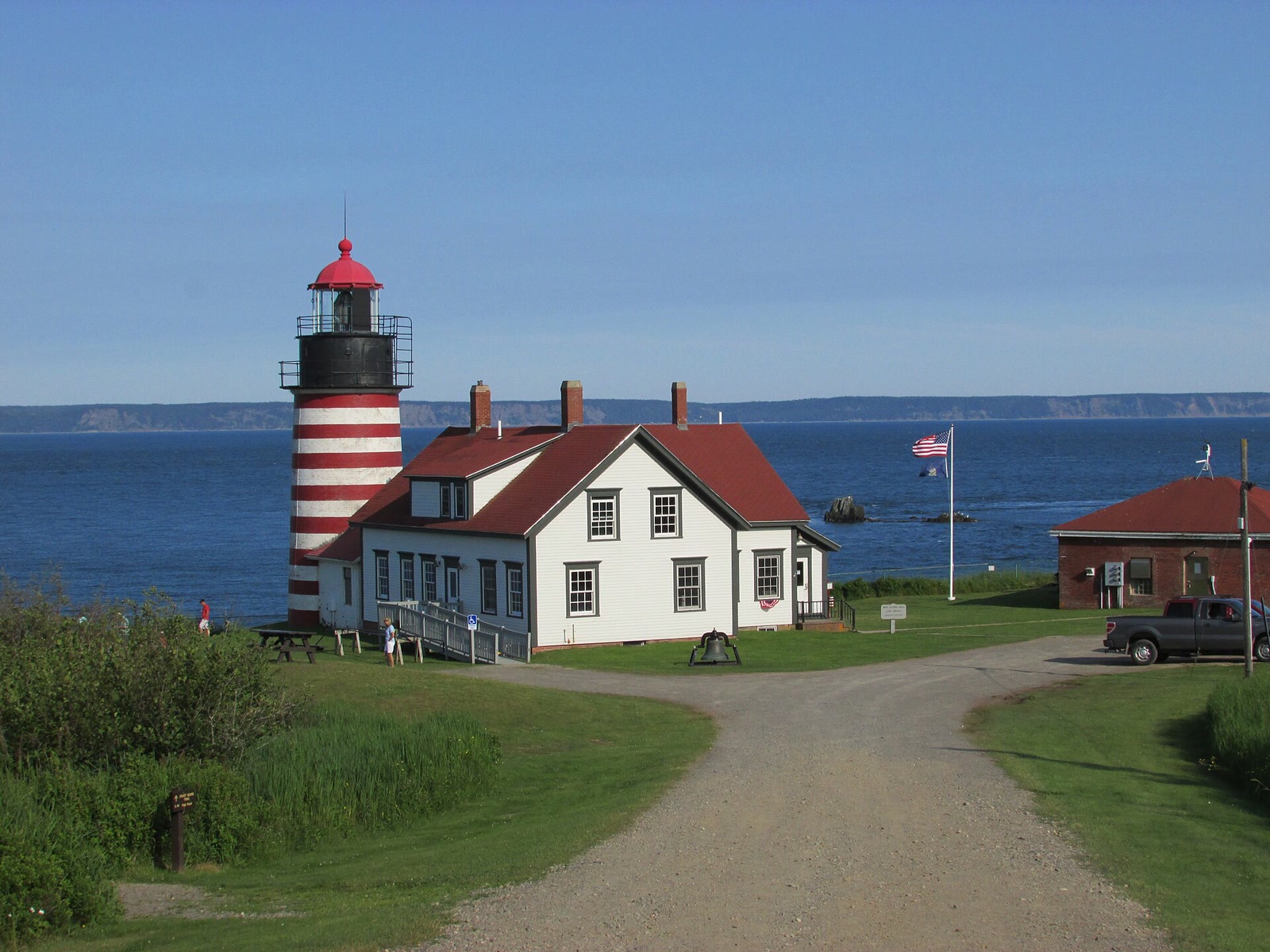
The light sits inside Quoddy Head State Park, 541 acres of trails, picnic areas and shorefront at the end of the road. The park is open from 9 a.m. to sunset daily from May 15 to October 15, and in the off season you can park outside the gate and walk in during daylight hours. The visitor centre, in the former keeper’s quarters, is open daily from 10 a.m. to 4 p.m. from Memorial Day weekend through mid-October, staffed by volunteers. The tower itself is closed to the public, but the grounds, the trails and the view across the channel are the reason to come. Come at sunrise if you can: this is the first place in the country to see it.
The Ones You Can Only Reach by Boat
Some of the best Maine lighthouses are the ones you cannot drive to at all, and they are worth a boat trip rather than a regret. Seguin Island Light is the prize of the group. It was commissioned by George Washington in 1795, making it Maine’s second-oldest lighthouse, and the current tower, built in 1857, is the third to stand on the island. It is also the highest light in Maine, standing about 180 feet above the ocean. Ferries run to the island in summer from Five Islands, Popham Beach and Bath, and the trip takes around half an hour each way, with two to three hours ashore to explore the 65-acre island, its trails, the museum and the gift shop. Summer keepers give guided tours to the top of the tower and out onto the catwalk around the nine-foot Fresnel lens. There is no dock on the island, so you transfer from the boat to a dinghy to get ashore.
Monhegan Island’s light is reached by ferry from Boothbay Harbor, and the island itself, with fewer than a hundred year-round residents, is worth the day on its own. Burnt Island Light, off Boothbay Harbor, is a regular stop on the harbour’s lighthouse cruises. If you only take one boat trip, make it a lighthouse cruise out of Boothbay Harbor or Bath: the routes pass a dozen lights in a single outing, including several you will never see from land. Book ahead in summer, dress for wind on the water even on a warm day, and remember that fog can cancel a sailing, so keep a land-based backup in your pocket.
Before You Go: Towers, Tickets and the Best Light
A few practical rules will save you more time than any single recommendation. First, assume the tower is closed unless the operator’s own site says otherwise. Across this list, only Pemaquid Point and Seguin Island open their towers on a regular seasonal schedule, and Portland Head opens its tower one day a year, on Maine Open Lighthouse Day each September. Everything else is a view from the grounds, which is still a good visit, but it is a different visit from the one many people imagine. Check hours and fees on the operator’s page the week you travel, because volunteer-run museums and seasonal parks shift their schedules year to year.
Second, plan around the light, not the clock. East-facing lights like Portland Head, Nubble and West Quoddy photograph best in the morning, when the sun is on the tower’s face; west-facing views like Bass Harbor Head belong to the late afternoon. The parking lots at Nubble, Pemaquid and Bass Harbor Head all fill by mid-morning in July and August, so the early start that gives you the best photograph also gives you the easiest parking. And third, give the coast its due: the drive from York to Lubec is about 250 miles of winding coastal road, so treat the twelve lights above as a three-day route rather than a single day’s checklist.