
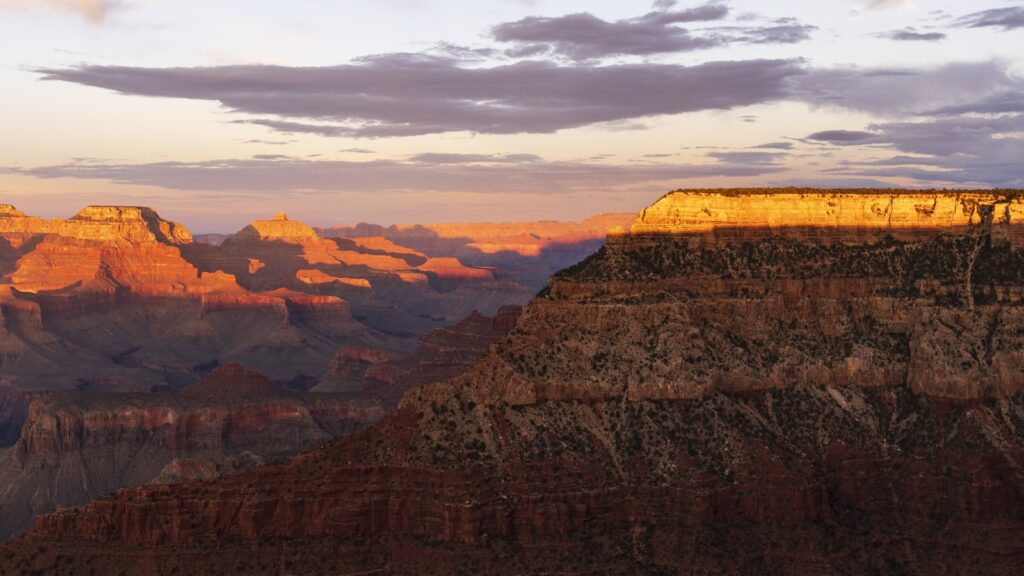
The Grand Canyon is the one American sight that does not need an introduction — and the one most people see wrong, by trying to do it in a few hours from a tour bus window. This Grand Canyon itinerary gives you a realistic plan for one or two days at the South Rim: the viewpoints in order, a hike below the rim if you want one, and what the trip costs. Every price below was checked on the official Park Service site on 11 November 2026 — and there is one thing you need to know before anything else, because it changes where you stay.
The short answer: one day covers the South Rim viewpoints and a sunset. Two days adds a hike below the rim and the Desert View drive, and it is the version worth doing if you can spare the time. Everything below is built around that, for two adults sharing a room.
Before You Go: What Is Closed in 2026
Read this first, because it changes the trip. After an August 2026 flash flood damaged the Transcanyon Waterline, the Park Service suspended all overnight stays inside the park, effective 31 August 2026 — Maswik Lodge, El Tovar Hotel, Bright Angel Lodge, Yavapai Lodge, Trailer Village, and Phantom Ranch are all closed to overnight guests, with Stage 4 water restrictions in force and no reopening date given. Lodging in Tusayan, the town just outside the South Entrance, is not affected — that is where this itinerary puts you.
The same flood shut off drinking water in the inner canyon: since 6 September there is no potable water in the inner canyon, including the Bright Angel Trail resthouses and Havasupai Gardens. Hikers must carry filtration or treatment, or carry all their water. The entire North Kaibab Trail, Phantom Ranch, Bright Angel Campground, and the Silver and Black suspension bridges are closed, and Bright Angel Campground stays closed through 4 January 2027. The North Rim is on limited fall day-use only, with no drinking water, food, or services, after its lodge was destroyed by fire in July 2025. And Lipan Point on the Desert View Drive is closed until 23 December 2026.
None of this stops a South Rim trip — the viewpoints, the shuttles, and the rim trails are all open. But do not book an in-park lodge for 2027 until the Park Service confirms reopening: booking sites still list them, and those listings conflict with the Park Service suspension.
How Many Days Do You Need at the Grand Canyon?
The Park Service does not publish a “one day or two days” rule — the framing below is this guide’s own recommendation, built on the park’s geography, not a Park Service standard. Here is the honest comparison.
| 1 day | 2 days | |
|---|---|---|
| What you see | Mather Point, Yavapai, Hermit Road viewpoints, sunset at Hopi Point | Everything in 1 day, plus a Bright Angel Trail hike below the rim and the Desert View Drive |
| Pace | Full day, sunrise to sunset | Comfortable, with a slow morning on Day 2 |
| Best for | A stop on a Las Vegas or Phoenix road trip | Anyone who wants to hike below the rim |
| Rough cost per person | About $167–$192 | About $316–$366 |
One day is enough to see the canyon properly from the rim — and for most visitors, the rim is the trip. Two days is the version where you go below it, which is the only way to understand the scale of the place. The South Rim is open 24 hours a day, 365 days a year, and 90% of the park’s visitors come here, so this itinerary is South Rim only.
Day 1: The South Rim Viewpoints
Start at the Grand Canyon Visitor Center and walk up to Mather Point, the first viewpoint most visitors see — and the one to come back to at sunrise. From there, continue east 0.7 miles to the Yavapai Observation Station, the geology museum on the rim, open 8 a.m. to 6 p.m. daily.
Spend the middle of the day on Hermit Road, the 7-mile road west from the Village with nine viewpoints in order: Trailview Overlook, Maricopa Point, Powell Point, Hopi Point, Mohave Point, The Abyss, Monument Creek Vista, Pima Point, and Hermits Rest. Private vehicles are closed on this road from March through November, so take the free Hermits Rest (Red Route) shuttle — it is included with your entrance fee — and hop off at two or three viewpoints rather than all nine. The Rim Trail between Hermits Rest and the South Kaibab trailhead is 7.8 miles if you want to walk a stretch of it.
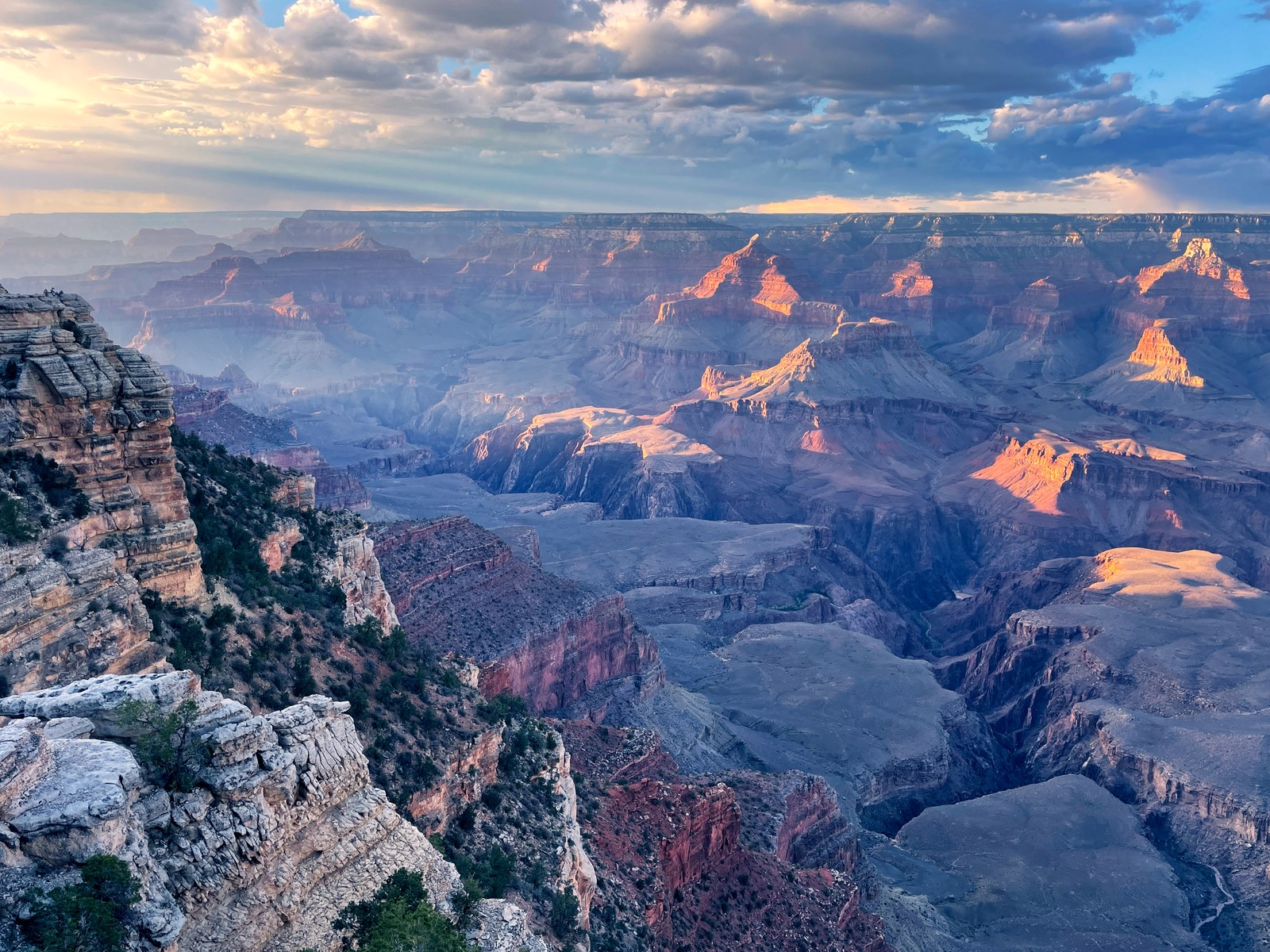
End the day at Hopi Point for sunset. The Park Service calls it “unquestionably the most desirable viewpoint for watching the sunset,” and it is right — arrive 90 minutes before sunset for a spot, and stay after the sun disappears, because the colours linger on the canyon walls. Mohave Point and Pima Point are the less-crowded alternatives on the same road.
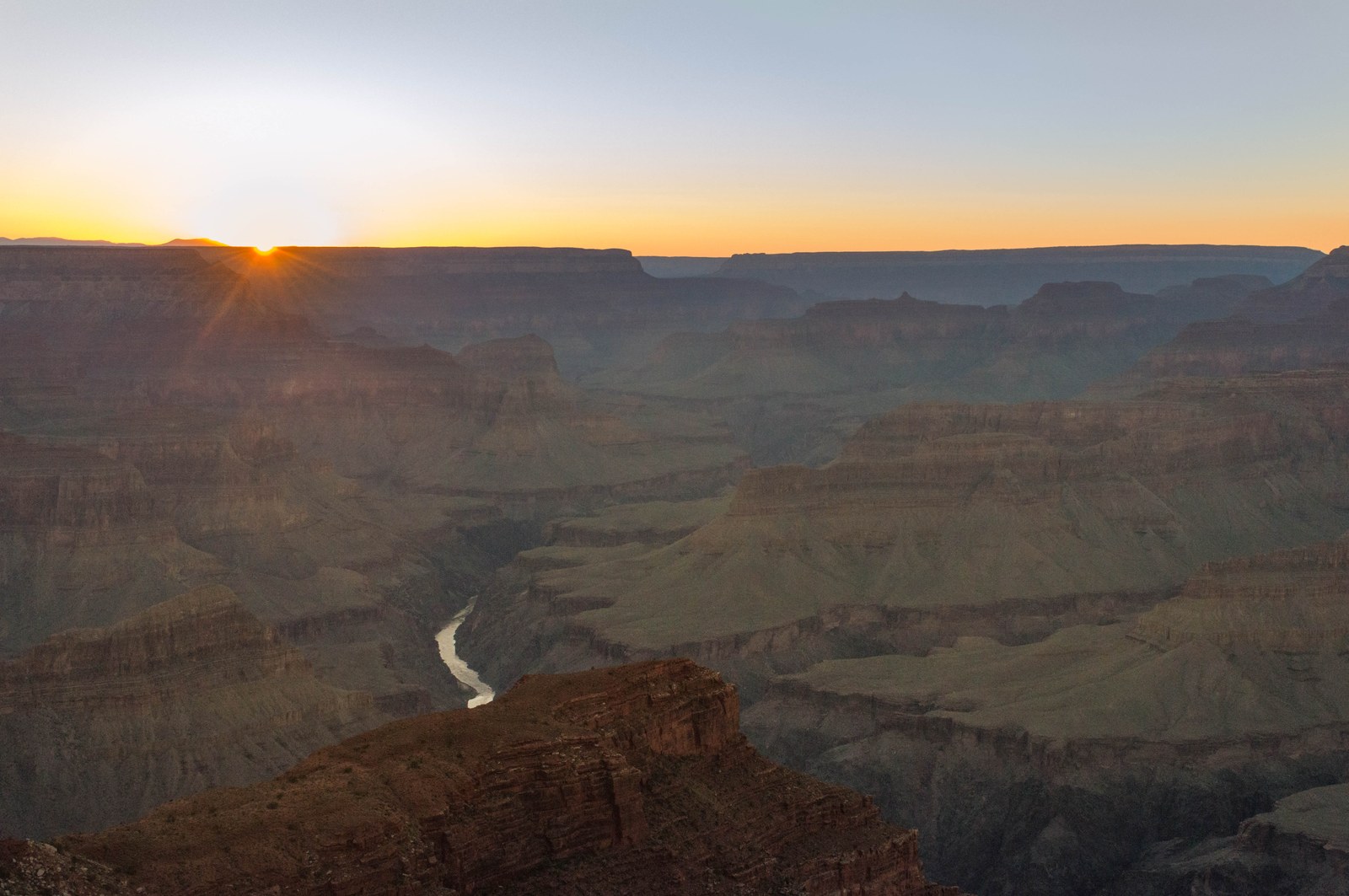
Day 2: Below the Rim on the Bright Angel Trail
Day 2 is the hike. The Bright Angel Trail runs 7.8 miles one-way from the rim to the river, dropping 4,460 feet — but you are not hiking to the river. The day hike is to the Mile-and-a-Half Resthouse (1.6 miles down, 3.2 miles round trip) or the 3-Mile Resthouse (3.1 miles down, 6.2 miles round trip), and back up. Both have toilets and an emergency phone, and both normally have water — but remember the current shutoff: there is no potable water in the inner canyon right now, so carry all your water or bring filtration.
Start early, before 8 a.m. The Park Service does not recommend hiking from the rim to the river and back in one day, and it warns against hiking between 10 a.m. and 4 p.m. in summer: the inner canyon reaches 106°F in July, and more than 300 rescues happen in the canyon every year. In warm months, each hiker should carry and drink about a gallon (4 litres) of water a day. The trail is wide and well-maintained, with switchbacks and shade shelters — the danger is the heat and the climb back up, not the trail itself.
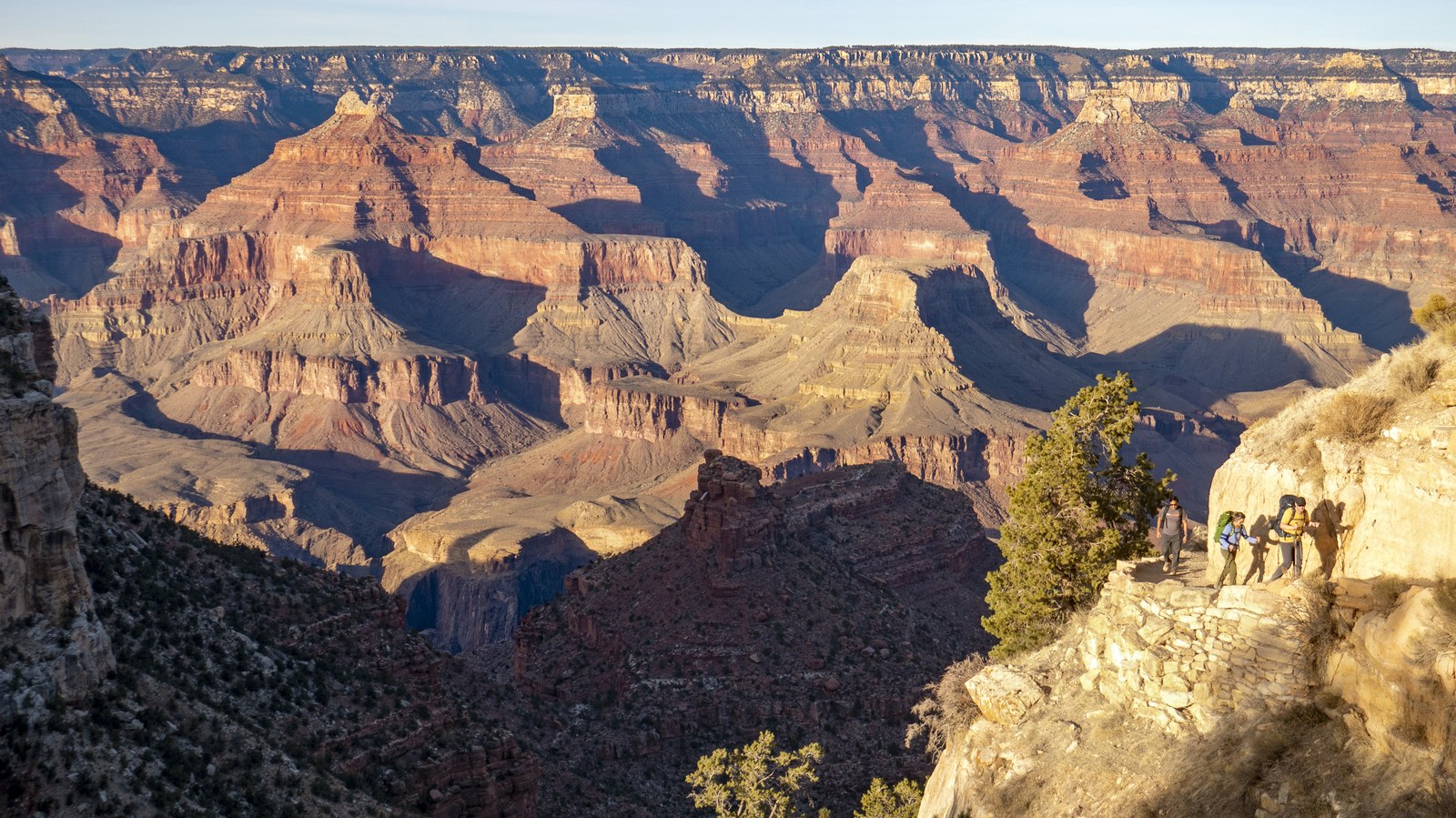
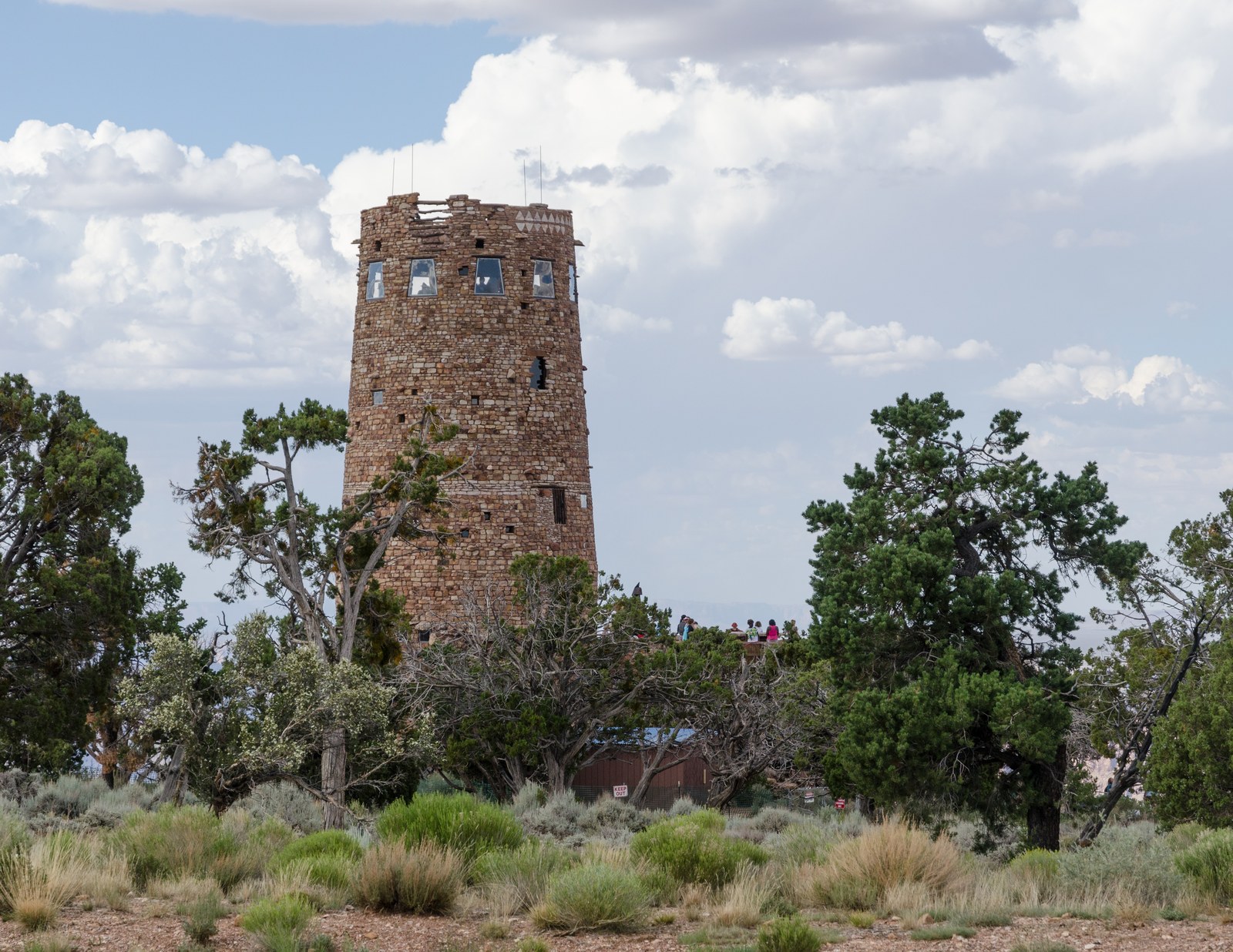
Spend the afternoon on the Desert View Drive, the 23-mile road east from the Village, about an hour of driving with six developed viewpoints: Pipe Creek Vista, Duck on a Rock, Grandview Point, Moran Point, Tusayan Pueblo, and Navajo Point, ending at the Desert View Watchtower — 70 feet tall, free to enter, with the View Room open 9 a.m. to 5 p.m. Skip Lipan Point on this drive: it is closed until 23 December 2026. The East Entrance is open 24 hours a day, so you can leave the park this way toward Flagstaff without backtracking.
What It Costs
Here is the full cost for one person, based on two adults sharing a room and the prices verified on 11 November 2026. The hotel is a single representative example — the Red Feather Lodge in Tusayan — not an average.
| Item | 1 day | 2 days |
|---|---|---|
| Park fee, per person (per vehicle ÷ 2) | $17.50 | $17.50 |
| Hotel, per person sharing | $99.35 | $198.71 |
| Food, per person (estimate) | $50–$75 | $100–$150 |
| Total per person | About $167–$192 | About $316–$366 |
The park fee is $35 per vehicle, valid for seven days, split between two adults. The hotel is the Red Feather Lodge at $176 a night — $198.70 after the 12.9% combined tax for one night, $397.41 for two nights, split between two adults. Free cancellation before 7 July 2027, no prepayment, pay at the property.
The food line is an estimate, not a verified price: roughly $50 to $75 per person per day for casual meals and snacks. The Park Service publishes no per-day food figure, and several in-park restaurants are closed or on shortened hours because of the flood and water restrictions — so plan on eating in Tusayan, seven miles south of the Village, where there are groceries and restaurants. Flights and the drive to the park are not included in these totals.
Where to Stay
Stay in Tusayan. It is the town one mile south of the South Entrance, and right now it is the only place to stay near the park: every in-park lodge is suspended, as the section above explains. The Red Feather Lodge used in the cost table is on State Route 64 in Tusayan — $176 a night, free cancellation, pay at the property. The Grand Canyon Hotel & Suites in the same town is $170 a night with breakfast included.
Do not book an in-park lodge — Maswik Lodge, Yavapai Lodge, El Tovar, or Bright Angel Lodge — for 2027 until the Park Service confirms reopening. Booking sites still show them, including a $400-a-night Maswik listing for July 2027, but those listings conflict with the suspension, and a booking made on one is not a room you can count on.
If you want to stay inside the park when it reopens, book as early as the Park Service allows: South Rim lodging normally books up well in advance, and it is strongly recommended to reserve in spring, summer, and fall.
Getting There
The South Rim is a drive, and the two approaches are from Las Vegas and Phoenix. Las Vegas to the South Rim is 4 hours 31 minutes and 280 miles via I-40. Phoenix to the South Rim is 3 hours 41 minutes and 229 miles via I-17. Flagstaff is 81 miles away, Williams 63 miles — the South Rim is about 60 minutes from I-40 at Williams and about 90 minutes from Flagstaff.
The nearest airports are Phoenix Sky Harbor, Las Vegas Harry Reid, and Flagstaff Pulliam, with limited air service into Grand Canyon Airport, seven miles south of the park, from Las Vegas. Most visitors fly into Phoenix or Las Vegas, rent a car, and make the canyon one stop on a longer Southwest road trip — which is the right way to do it, because the drive in is half the experience.
When to Go
The South Rim is open all year, and the seasons change the trip completely. Summer is warm and pleasant on the rim — July averages 84°F in the day and 54°F at night — with afternoon thunderstorms and the best stargazing in June. But the inner canyon is a different climate: 106°F in July, over 100°F all summer, with the temperature rising 5.5°F for every 1,000 feet you descend. Winter is cold and sunny — January averages 41°F in the day and 18°F at night — with snow on the rim and the fewest visitors of the year; November through February is the least crowded season.
Spring brings wind and wildflowers in May, and fall brings cool air and colour in September and October. If your dates are flexible, late September or October gives you cool hiking weather, open roads, and thinner crowds than summer — with the one catch that the North Rim is closed by then, which does not matter for a South Rim itinerary.
Frequently Asked Questions
How many days do you need at the Grand Canyon?
One day covers the South Rim viewpoints and a sunset. Two days adds a hike below the rim on the Bright Angel Trail and the Desert View Drive. The Park Service publishes no official rule — this is the guide’s recommendation.
Can you do the Grand Canyon in one day?
Yes, from the rim. One full day — sunrise at Mather Point, Hermit Road by shuttle, sunset at Hopi Point — is a proper visit. You will not hike below the rim, and you will not see Desert View, but you will have seen the canyon.
Is the North Rim open?
Not for a normal visit in 2026. Its lodge was destroyed by fire in July 2025, and the North Rim is on limited fall day-use only until 30 November 2026, with no drinking water, food, or services. The South Rim is the year-round side — 90% of visitors come here.
Can you stay inside the park?
Not right now. All in-park overnight stays are suspended since 31 August 2026, with no reopening date given. Stay in Tusayan, one mile outside the South Entrance.
Is the Bright Angel Trail safe?
It is well-maintained and wide, with resthouses and ranger presence — but the heat is the risk, not the trail. Do not hike rim to river and back in one day, do not hike between 10 a.m. and 4 p.m. in summer, and carry about a gallon of water per person per day in warm months. Right now there is no potable water in the inner canyon at all, so carry filtration or all your water.
The Short Version
The Grand Canyon is a one-day sight with a two-day soul. Give it one day and you will see the viewpoints, the sunset, and the scale of it from the rim. Give it two and you will walk below the rim on the Bright Angel Trail and drive the Desert View road to the Watchtower. Stay in Tusayan, start the hike early, carry more water than you think you need — and check the Park Service conditions page before you go, because in 2026 the closures are the story as much as the views. For the viewpoints in detail, read our Grand Canyon travel guide.
Prices and sources
All prices checked 11 Nov 2026 on official sites. Prices are “from” prices and may change; check the linked source before booking.
- Entrance fee $35/vehicle, 7 days; nonresidents +$100 per person 16+ from 1 Jan 2026 — https://www.nps.gov/grca/planyourvisit/fees.htm
- In-park lodging suspended since 31 Aug 2026; water restrictions; inner-canyon closures — https://www.nps.gov/grca/planyourvisit/lodging.htm — https://www.nps.gov/grca/planyourvisit/conditions.htm
- South Rim viewpoints, Hermit Road, Desert View Drive — https://www.nps.gov/grca/planyourvisit/grand-canyon-visitor-center.htm — https://www.nps.gov/grca/planyourvisit/hermit-road.htm — https://www.nps.gov/grca/planyourvisit/desert-view-drive.htm
- Bright Angel Trail distances, water, heat warnings — https://www.nps.gov/grca/planyourvisit/day-hiking.htm — https://www.nps.gov/grca/planyourvisit/trail-distances.htm — https://www.nps.gov/grca/planyourvisit/hike-smart.htm
- North Rim status 2026 — https://www.nps.gov/grca/northrimstatus.htm
- Sunrise/sunset viewpoints (Hopi Point best for sunset) — https://www.nps.gov/grca/planyourvisit/sunrise_set_moon.htm
- Hotel example: Red Feather Lodge, Tusayan, 2 nights 9–11 Jul 2027, $352 before tax / $397.41 after 12.9% tax — https://www.booking.com/hotel/us/red-feather.html
- Driving distances (Las Vegas 278 miles; Phoenix 231 miles) — https://www.nps.gov/grca/planyourvisit/directions_s_rim.htm
- Seasons and temperatures — https://www.nps.gov/grca/learn/nature/weather.htm